

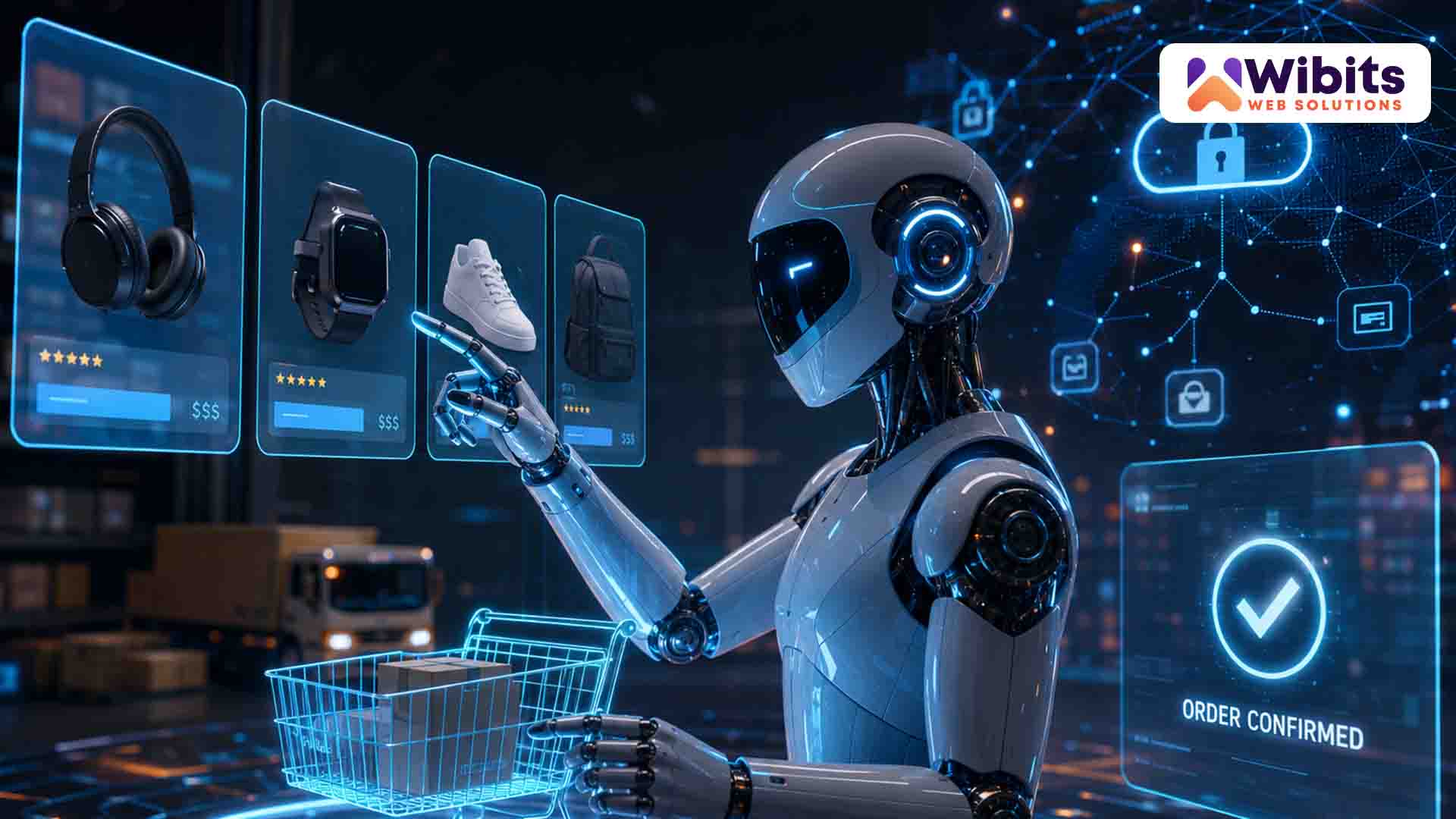
Imagine waking up to find that your highest-converting customer isn’t a human scrolling on a phone during lunch, but a software algorithm. This isn’t a speculative scenario for the distant future. Right now, your Google Ads account is beginning to serve a invisible buyer: an AI agent. This digital proxy is independently comparing product attributes, evaluating real-time inventory, cross-checking shipping policies, and executing checkouts on behalf of human consumers.
We are witnessing agentic commerce, the most disruptive structural paradigm shift in e-commerce paid media since the transition to mobile devices.
This isn’t an experimental pilot or an industry forecast. The monetary scale of this shift is already massive. Data from Salesforce revealed that during Cyber Week, AI and autonomous agents drove roughly $67 billion in global sales, capturing 20% of all online orders.

For brands utilizing Performance Max, Standard Shopping, or Search campaigns, this evolution changes the mechanics of digital media. Your product feed is shifting from a passive digital catalog into an active programmatic bidding signal. A new, highly monetized surface has opened inside Google’s AI Mode, and traditional client-side conversion tracking is breaking in real time based on how these autonomous agents choose to check out.
The current systems and campaigns will not suddenly stop functioning. Instead, the inputs required to win the auction are shifting. Advertisers who understand these programmatic rules early will establish a distinct competitive edge.
The technological landscape supporting autonomous shopping is expanding rapidly, with major platforms deploying infrastructure designed specifically for agent-to-business transactions.
| Platform/ Provider | Agentic Integration & Infrastructure |
| “Buy for Me” in AI Mode; Universal Commerce Protocol (UCP) | |
| OpenAI | Instant Checkout in ChatGPT via native transaction protocols |
| Perplexity | Native shopping execution integrated directly with PayPal |
| Visa, Mastercard, Stripe | Specialized agent-ready payment rails & cryptographic consent |
Google’s agentic checkout engine, branded Buy for Me, operates natively within AI Mode alongside major launch partners like Wayfair, Chewy, and Quince. To standardize these interactions, Google introduced the Universal Commerce Protocol (UCP), an open-source standard built in collaboration with Shopify, Etsy, Target, and Walmart, and backed by financial institutions including Visa and American Express.
Simultaneously, OpenAI has deployed Instant Checkout within ChatGPT using proprietary transaction rails backed by Stripe, while Perplexity has integrated deep transactional workflows via PayPal. When discovery, intent matching, and financial settlement reorganize around autonomous software within a compressed timeframe, it marks a permanent shift in consumer purchasing behavior.
Within standard Google Shopping and Performance Max environments, the product feed has long been utilized for contextual matching and query routing. Agentic commerce accelerates this dependency. When an AI agent evaluates a product category, it bypasses ad copy, visual assets, and emotional branding elements. Instead, it reads structured data matrices:
The agent matches consumer-defined constraints against these specific data points to filter products before a human ever interfaces with the selection.
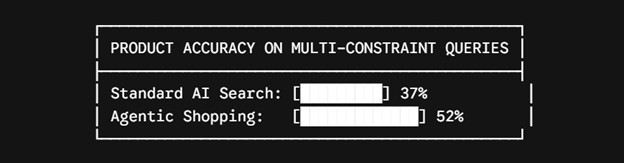
Data from OpenAI’s evaluation of specialized conversational shopping tools highlights this shift. Enhanced shopping tools achieved 52% product accuracy on multi-constraint queries, compared to only 37% for standard conversational search. Here, “product accuracy” measures how precisely the returned results match highly specific user requirements regarding material, dimensions, color, and price floors.
Recognizing this behavior, Google introduced dedicated conversational attributes within Merchant Center, allowing brands to supply structural data tailored directly to natural language evaluation.
For e-commerce media teams, this requires a shift in perspective. Feed quality can no longer be treated as an administrative or IT maintenance task. It is a critical component of campaign performance. If your product feed is unoptimized while resources remain focused entirely on ad creative, your brand risk being excluded by the filtering mechanisms of autonomous buyers. The product feed must be managed with the same testing rigor and optimization cadence typically reserved for creative assets.
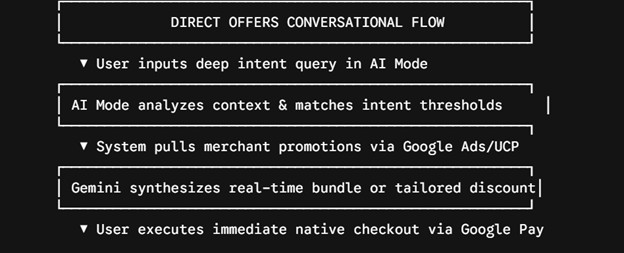
A frequently overlooked aspect of this shift is the deployment of dedicated ad units designed explicitly for autonomous environments. Direct Offers represents Google’s pilot ad format that injects merchant-funded promotions directly into AI Mode and Gemini when high commercial intent is programmatically detected. Rather than managing traditional keyword or audience bids, advertisers configure offer logic, distribution guardrails, and margin limits within campaign parameters. Google’s AI models then evaluate the conversation context in real time to present optimized offers. Google’s ads liaison described this format as functioning less like a static advertisement and more like an autonomous salesperson actively negotiating terms on behalf of the merchant.
This structural change impacts the core strategy of media buying:
To do well on this surface you need to have a plan for promoting your products before you start. The people in charge of online stores have to pick which products they want to sell set a minimum amount of money they are willing to make on each product and decide if they should lower the prices or offer special deals with extra things. This is really important for the e-commerce teams because they have to make these choices to be successful, on this surface. The e-commerce teams must think about what products to sell and how to sell them on this surface.
Shopping advertisements serve natively within Google’s conversational AI surfaces. Placements within AI Mode are sourced directly from active Shopping and Performance Max campaigns, appearing with a “Sponsored” label.
Consequently, core conversion campaigns are already interacting with agent-mediated environments. However, tracking this activity introduces visibility challenges. As a greater percentage of the consumer journey takes place inside AI Mode, traditional granular touchpoint reporting becomes more opaque, accelerating a trend already observed with broad query matching.
To maintain clarity, media buyers must utilize the advanced control mechanisms Google has introduced over the past several quarters:
The introduction of autonomous checkout mechanisms impacts standard click-based attribution modeling in two distinct ways, depending on the technological path chosen by the agent:
Under this model, the AI agent navigates directly to the merchant’s web domain to complete the transaction, keeping the brand as the merchant of record. Because the final transaction executes on your native infrastructure, client-side conversion tags (such as the Google tag or Meta Pixel) will fire successfully.
However, the underlying attribution link frequently breaks. Because the agent’s automated session does not transmit a standard click identifier ($gclid$ or $wbraid$) through a standard browser session lifecycle, the conversion is recorded, but the specific campaign tracking is lost.
When a checkout runs directly through UCP, the entire transaction occurs within the AI interface (such as Gemini or Google Search AI Mode). While the retailer remains the merchant of record for fulfillment, the customer never loads the merchant’s web domain or enters a standard browser session.
This environment completely bypasses client-side web tracking. Pixels and third-party tags cannot detect the event because no on-site activity occurs. Advertisers must rely on conversion data processed via server-to-server connections and Merchant Center data feeds.
| “Buy For Me” Checkout Path | UCP Native Checkout Path |
| Occurs on merchant website | Occurs entirely in AI Mode |
| Conversion tag fires | Client-side pixels go blind |
| Ad click attribution breaks | Relies on Merchant Center S2S |
Because the platform documentation on -channel attribution for UCP is still being updated, using fixed metrics from one platform can lead to wrong choices.
E-commerce brands should use server-side tracking with Conversions API or CAPI to get data.
This way they can also use Conversions.
They should measure performance with a mix of metrics, like Marketing Efficiency Ratio. Do incrementality testing to get a clear picture.
To make your accounts work with commerce without messing up the campaigns that are making you money right now do these things first:
The companies that do well in this world will not be the ones with the best advertisements. They will be the ones that have their product information, pricing rules and tracking systems working well for buyers who make purchases on their own without looking at ads. The future of e-commerce media with Wibits Web Solutions is, about making things work smoothly for these buyers.
Managing this technical transition requires a deep understanding of feed engineering, advanced data tracking, and modern campaign architectures. Wibits Web Solutions is a marketing agency in India that helps businesses deal with big changes.Our team is in Tamil Nadu. We are known as the best digital marketing company in Nagercoil.
We help brands with technical things to update their online store.If your business needs to change its Google Merchant Center feeds so people can ask questions or if you need to track things on the server side or if you need to keep your profits safe, with Performance Max and Direct Offers Wibits Web Solutions can help you with a plan. Wibits Web Solutions gives you the help you need to stay ahead of other businesses.
1. Will agentic commerce completely replace standard search and shopping ads?
No. Autonomous shopping is an additional layer within the digital marketing landscape. While AI agents are rapidly adopting high-intent, constraint-based buying tasks, traditional visual shopping and text search ads remain highly effective for human-driven product discovery and brand research.
2. How can I verify if my products are being displayed in Google’s AI Mode?
You can monitor this performance via the AI performance insights console inside Merchant Center Next. This tool provides visibility into your brand’s share of voice across conversational search surfaces in supported regions, including India, Canada, Australia, and the US.
3. What specific attribute is required to activate native checkout inside AI Mode?
To enable the native checkout experience through the Universal Commerce Protocol (UCP), your product feed must actively populate the native_commerce product attribute within Google Merchant Center, alongside an active Google Pay and Wallet integration.
4. Should I reallocate my entire budget away from platforms like Meta to support this?
Absolutely not. Agentic commerce is additive. The vast majority of immediate e-commerce revenue still flows through traditional discovery and intent channels, including Meta Ads and standard Google Search. Maintain your core performance budgets while systematically optimizing your backend data feeds to capture autonomous traffic.

For years, website owners have focused on one big question: Can Google find my website?…

Think about the websites you visit without even thinking twice. Maybe there's a technology site…
For years, the goal was pretty simple. Get your website onto Google. Get it near…
You wake up to an urgent notification, a harsh review, an old legal scrape, or…
Remember when building a decent website and tossing in a few keywords was enough to…
"I think we're done with Google Ads." A business owner said that recently. I didn't…
You may have spent months working in SEO or working with a best SEO company…
Imagine walking into a hardware store looking for a certain type of strong garden hose.…
You open Google Analytics. The numbers don't look bad. People are visiting the website. Some…