

The uncomfortable truth: your SEO reports might be lying to you!
Your website ranks on page one.
Your traffic graph is climbing.
Your SEO reports look impressive.
But your business isn’t growing.
If this sounds familiar, you’re not alone.
Many businesses working with a digital marketing company in Nagercoil or even a large digital marketing agency in India face the same issue: SEO metrics that look good but don’t drive revenue.
Welcome to the era where traditional SEO KPIs are no longer enough.
This disconnect is exactly where most businesses find themselves today.
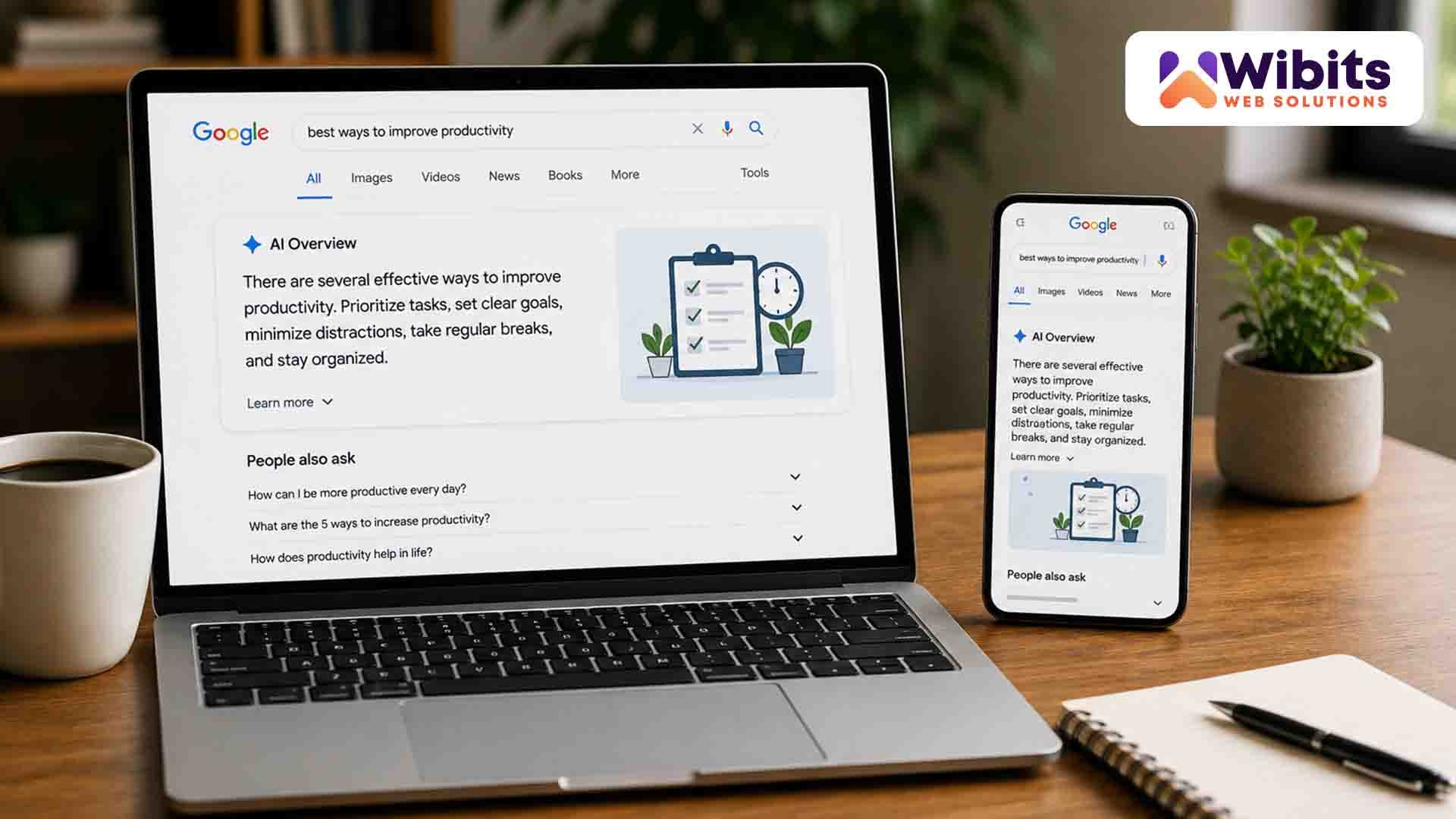
For years, SEO success was measured using rankings, clicks, and traffic. But the digital landscape has shifted dramatically. With AI-driven search, zero-click results, and stricter privacy rules, those traditional metrics don’t tell the full story anymore.
At Wibits Web Solutions, we see this pattern repeatedly: businesses chasing metrics that look good but don’t translate into real growth. It’s not a data problem, it’s a measurement problem.
This blog will help you understand:
SEO KPIs (Key Performance Indicators) are measurable values used to evaluate the success of your search engine optimization efforts. Traditional KPIs include rankings, organic traffic, and click-through rates.
However, modern SEO requires tracking business-driven KPIs like conversions, revenue, and customer value.
Also read: What Strategies Prove Most Effective For Generating Digital Leads?
Most SEO teams aren’t lacking data, they’re overwhelmed by it.
Over time, businesses accumulate what we call metric debt: tracking and optimizing for KPIs that no longer reflect how customers behave or how growth actually happens.
Earlier, ranking #1 on Google almost guaranteed traffic and traffic often led to conversions. Today, that chain is broken.
Here’s why:
Yet many teams still report success the same way they did five years ago.
Let’s be clear, metrics like rankings and traffic are not useless. But relying on them alone is risky.
They’re what we call vanity metrics: numbers that look impressive but don’t necessarily drive business outcomes.
For example, a page ranking #1 for a high-volume keyword might bring thousands of visitors, but if those visitors don’t convert, what’s the real value?
Meanwhile, a low-traffic page targeting high-intent users might generate actual revenue but often goes unnoticed in reports.
That’s where most SEO strategies start to fall apart.
Modern SEO is no longer just about visibility it’s about impact.
To understand this shift, let’s break SEO metrics into three meaningful layers:
| Category | What It Measures | Examples | Why It Matters |
| Operational Signals | Whether SEO is functioning properly | Crawlability, indexation, page speed, content output | Foundation for visibility |
| Engagement Signals | How users interact with your content | Time on page, scroll depth, return visits, micro-conversions | Indicates interest and relevance |
| Business Outcomes | Real business impact | Leads, revenue, CAC, customer lifetime value | True measure of success |
These are the technical essentials that ensure your website can even compete in search.
Examples include:
These metrics are necessary but they don’t prove success on their own.
Once users land on your site, the question becomes: Do they care?
This is where engagement metrics come in:
These signals show whether your content aligns with user expectations.
Still, they’re only part of the story.
This is where many teams hesitate but this is exactly where SEO needs to go.
Key outcome metrics include:
If your SEO reports don’t include these, your strategy will always be questioned, especially during budget reviews.
Transitioning from traffic-focused metrics to revenue-driven KPIs isn’t easy.
Here’s why:
But staying comfortable comes at a cost such as missed growth opportunities.
You don’t need to overhaul everything overnight. The smartest approach is gradual and structured.
Start by reviewing your current SEO reports.
Ask:
You’ll likely find that most of your KPIs fall into operational tracking.
That’s normal but it’s also incomplete.
Not every page serves the same purpose.
Categorize your content into:
This helps you understand intent alignment, which is critical for conversions.
Start small. Add just one or two metrics that tie SEO to business results.
Examples:
Even a single outcome-based KPI can transform how SEO is perceived.
Don’t remove old metrics immediately.
Instead:
This builds a compelling story and earns stakeholder trust.
Changing KPIs isn’t just a technical shift, it’s a mindset shift.
People resist change because:
The solution? Reframe the conversation.
Instead of saying:
“We’re changing our KPIs”
Say:
“We’re testing how organic traffic impacts real business outcomes over the next 8 weeks.”
This makes the shift feel like an experiment, not a risk.
One of the biggest changes in SEO today is the rise of zero-click searches.
Users now:
This means:
SEO is evolving from a traffic channel into a discovery and influence channel.
Also read: The Role of AI in Modern SEO: How to Stay Ahead of the Game
To stay competitive, your SEO strategy needs to evolve continuously.
Here’s how:
You don’t need complex tools.
A practical setup includes:
Start simple and scale as needed.
Set a quarterly review cycle:
Think of your KPI system as a living framework, not a fixed structure.
High search volume doesn’t always mean high value.
Instead, prioritize:
This shift alone can dramatically improve ROI.
Great SEO teams don’t just report numbers, they explain them.
Instead of saying:
Say:
That’s the difference between reporting and storytelling.
If you continue relying on outdated KPIs:
On the flip side, when you align SEO with business outcomes:
Today, businesses are under more pressure to prove ROI than ever before.
Whether you’re working with a digital marketing company in Nagercoil or partnering with a digital marketing agency in India, the expectation is the same: Show real results, not just rankings.
This is especially true when choosing the best SEO company in Nagercoil or anywhere else because businesses no longer want reports; they want impact.
SEO isn’t failing, measurement is.
The way we track success needs to catch up with how search actually works today.
At Wibits Web Solutions, we don’t just focus on rankings or traffic, we align SEO with real business outcomes. Our approach ensures that every optimization effort contributes to measurable growth, whether that’s leads, revenue, or long-term customer value.
If your current SEO strategy feels disconnected from your business goals, it’s time to rethink your KPIs.
Because at the end of the day, if you can’t measure value, you can’t defend your SEO.
And if you can’t defend it, you can’t grow it.
1. What are the most important SEO KPIs today?
Business metrics like conversions, revenue, and customer value are the most important.
2. Why is my website getting traffic but no leads?
Your content may not match user intent or target high-converting keywords.
3. How do I optimize for AI search?
Use structured content, direct answers, and intent-focused topics.
4. How long does it take to shift to better KPIs?
Most businesses take 2 to 3 months to transition and start seeing meaningful insights from new metrics.
5. Can small businesses implement this approach?
Absolutely. Even tracking one outcome-based metric can significantly improve how SEO performance is evaluated.

Let's say you own a digital marketing company in Nagercoil. Your website is doing reasonably…
Google has a new system called SAFE, and it has caught the attention of people…
Think about the last time you searched for something online. Most of the time, you…

The internet search methods have changed. Now rather than accessing tens of sites one would…

A small business already has plenty on its plate. Then it has to compete online…
A potential customer opens ChatGPT and asks, “Who are the best companies for SEO in…

For years, website owners have focused on one big question: Can Google find my website?…

Think about the websites you visit without even thinking twice. Maybe there's a technology site…
For years, the goal was pretty simple. Get your website onto Google. Get it near…

You wake up to an urgent notification, a harsh review, an old legal scrape, or…