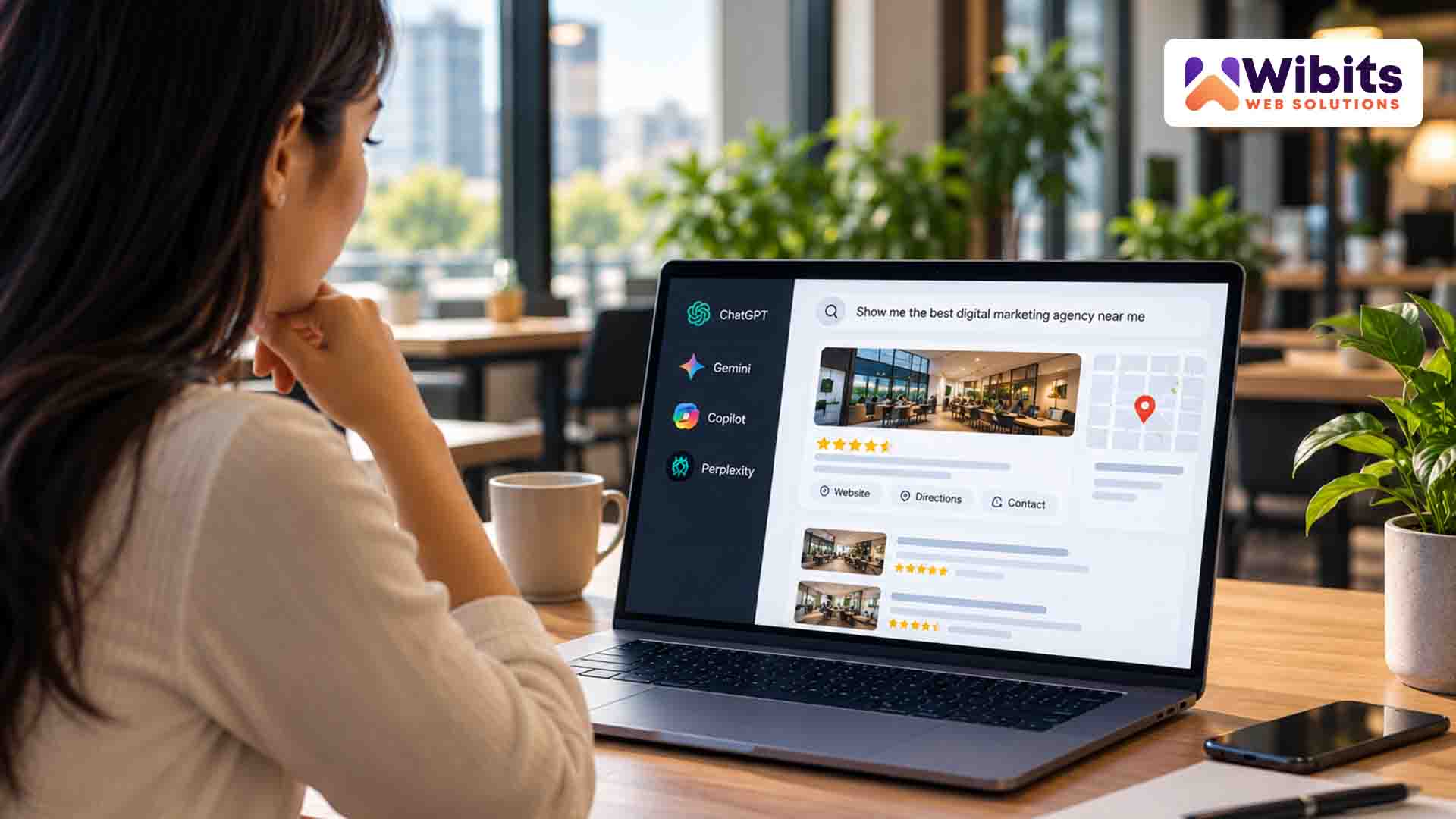
A potential customer opens ChatGPT and asks, “Who are the best companies for SEO in India?” Or they ask Google a longer question about finding a web design company in Nagercoil.
Your competitor gets mentioned.
You don’t.
That is becoming a real consideration for businesses that have spent years thinking about Google rankings. People are still searching Google, of course, but they now have other ways to find answers. Google itself says AI Overviews are used by more than 1.5 billion people each month, and the company has been expanding AI features that are designed to handle longer and more complicated questions.
So the question isn’t whether search is changing. It is.
The more useful question for a business is whether its online presence is keeping up.
The old search journey was fairly straightforward. You typed something into Google, looked through the results and picked a website that seemed useful.
Now you can ask a much more specific question and get a written response before you’ve clicked anywhere.
That matters because the search engine is doing more of the sorting for you.
Pew Research Center’s analysis of 68,879 Google searches from March 2025 gives a good idea of how quickly this is becoming part of ordinary search. Around 58% of the people in its study encountered an AI-generated summary at least once during the month.
And the searches most likely to produce these summaries aren’t necessarily short keyword searches. Pew found that 60% of searches beginning with question words such as “who,” “what,” “when” or “why” produced an AI summary, compared with only 8% of one- or two-word searches.
That tells us something important: people aren’t just searching for words. They’re increasingly asking questions.
Think about the difference between these two searches:
“SEO company India”
and
“I run a small business in India. What should I look for when choosing an SEO company?”
They’re looking for roughly the same thing, but the second search gives the system much more context.
Google has acknowledged this shift too. When discussing AI Mode, the company said queries there are, on average, twice as long as traditional Search queries.
That changes what a useful website looks like.
A page that simply repeats a service name twenty times isn’t particularly helpful when someone is asking a detailed question. A page that actually explains the service, answers common concerns and gives some useful context has much more to offer.
Absolutely.
It would be a mistake to read about AI search and conclude that normal SEO no longer matters. Google Search is still a huge source of information and traffic, and the basic things that make a website useful haven’t suddenly disappeared.
A technically sound website still matters. Good content still matters. Relevant pages still matter. Your business still needs to be visible when somebody searches in the traditional way.
The difference is that there are now more ways for people to discover that information.
Someone might find a service page through Google. Someone else could discover your business through a local result. Another person might ask an AI tool for several recommendations and start comparing the companies it mentions.
Good search engine optimization needs to make sense across those different journeys.
This is where a lot of websites have a problem.
The people inside a company know exactly what they offer. They know which industries they work with, which locations they serve and what makes their service different.
A visitor doesn’t have that background.
Neither does an AI system.
If your homepage says, “We help businesses grow online,” that’s pleasant enough, but it doesn’t say very much. A potential customer still has to work out whether you provide SEO, web development, advertising, content or something else.
Clear information gives both people and search systems something to work with.
For example, a company offering SEO services in Nagercoil should make that service and location clear without turning every paragraph into a variation of the same keyword. Explain what the service involves, what sort of businesses it suits and what problems it is intended to solve.
That is useful content because a customer can actually do something with it.
Local search hasn’t disappeared just because AI has arrived.
If somebody wants a service provider in Nagercoil, Coimbatore or another specific location, that location is part of the question. A business needs to make its connection to that area clear.
That doesn’t mean adding the city name to every heading you can find.
In fact, that usually makes the website sound strange.
Talk naturally about the areas you serve. Include relevant local examples. Ensure that your company’s information is consistent on your website and in all other business listings. Create content that is helpful to your customers in all your business locations.
This is essentially local SEO. It’s just as valuable whether someone finds out about you through a regular search or an AI recommendation.
Your website is important, but it’s not everything.
Your reviews, business listings, trade journals, and many other websites all provide information about your business. When lots of sources describe your company in a similar way, they give AI a clearer idea about your business and its activities.
This is why it’s important to monitor the overall online presence instead of simply thinking about your website.
You don’t need hundreds of random mentions.
A few relevant and trustworthy sources are far more useful than a long list of websites that nobody has ever heard of.
This is likely the aspect of marketing that deserves most consideration from businesses. Being referenced in a response from AI sounds awesome, but that does not guarantee any visits to the business.
According to Pew’s 2025 analysis, traditional search results were clicked in 8% of cases if the search engine’s AI produced a summary. Without the AI summary, that percentage was 15%. Also, links within the AI summary were clicked only in 1% of cases.
Although those numbers relate to a specific study of browsing behavior in the United States, they can still be instructive. They illustrate that people receive necessary information without visiting the giving websites.
That means brand visibility matters in a slightly different way.
If someone sees your company mentioned while researching a service, they may remember the name even if they don’t click immediately. They may search for you later, check your reviews or go directly to your website.
The click isn’t necessarily the whole story anymore.
There’s no secret piece of code that makes a company appear in ChatGPT or Google AI Overviews.
Anyone promising guaranteed placement should probably make you a little cautious.
Instead, start with the things you can control.
Make sure your website clearly explains what you do. Create useful service pages instead of thin pages written mainly to target keywords. Answer the questions customers actually ask before they contact you. Keep your business details current, and make sure your online presence doesn’t contradict itself from one website to another.
And don’t forget the boring technical stuff.
A great article isn’t much help if the website is slow, difficult to navigate or impossible to use on a phone.
AI visibility isn’t a replacement for having a good website. If anything, it gives you another reason to make sure the website deserves to be found.
This is where I’d be careful.
The moment businesses hear about AI search, there’s a temptation to start producing content that sounds like it was written specifically for a machine.
That’s usually when the writing becomes awful.
Every sentence starts carrying a keyword. Every paragraph says the same thing slightly differently. Pages become stuffed with questions that nobody would actually ask.
A better approach is much simpler: write something useful.
If a customer asked you a question over the phone, how would you answer it? What would you explain? What would you warn them about? What would you want them to understand before spending their money?
Put that on the website.
You don’t have to make every paragraph clever. It just needs to be clear, accurate and worth reading.
No, and that’s worth saying out loud.
AI-generated answers can change. Search systems use different sources and different methods, and there is no reliable way to force a particular company into every answer.
What you can do is make your business easier to understand and easier to trust.
That’s a much more sensible goal.
A clear website, useful content, genuine reviews, accurate business information and a solid online reputation will continue to help even when the technology behind search changes again.
And it will change again.
One might be lured into perceiving AI search as simply just another algorithm that needs a touch of fine-tuning.
I, however, do not consider it a productive approach.
When someone poses the query of what the company does to AI, one should make sure that the astute website provides a straightforward response for AI’s needs.
That’s the sweet spot.
You aren’t writing for a robot and hoping a customer understands it. You’re building an online presence that explains the business properly, and the machines get to understand it along the way.
So, can your business be found when someone asks AI?
Have a look at your website and ask yourself a slightly different question: if an AI had to explain my business to a potential customer, would I be happy with the answer?
If you’re not sure, that’s probably the part worth working on.

The internet search methods have changed. Now rather than accessing tens of sites one would…
A small business already has plenty on its plate. Then it has to compete online…
A potential customer opens ChatGPT and asks, “Who are the best companies for SEO in…

For years, website owners have focused on one big question: Can Google find my website?…

Think about the websites you visit without even thinking twice. Maybe there's a technology site…
For years, the goal was pretty simple. Get your website onto Google. Get it near…

You wake up to an urgent notification, a harsh review, an old legal scrape, or…

Remember when building a decent website and tossing in a few keywords was enough to…

"I think we're done with Google Ads." A business owner said that recently. I didn't…