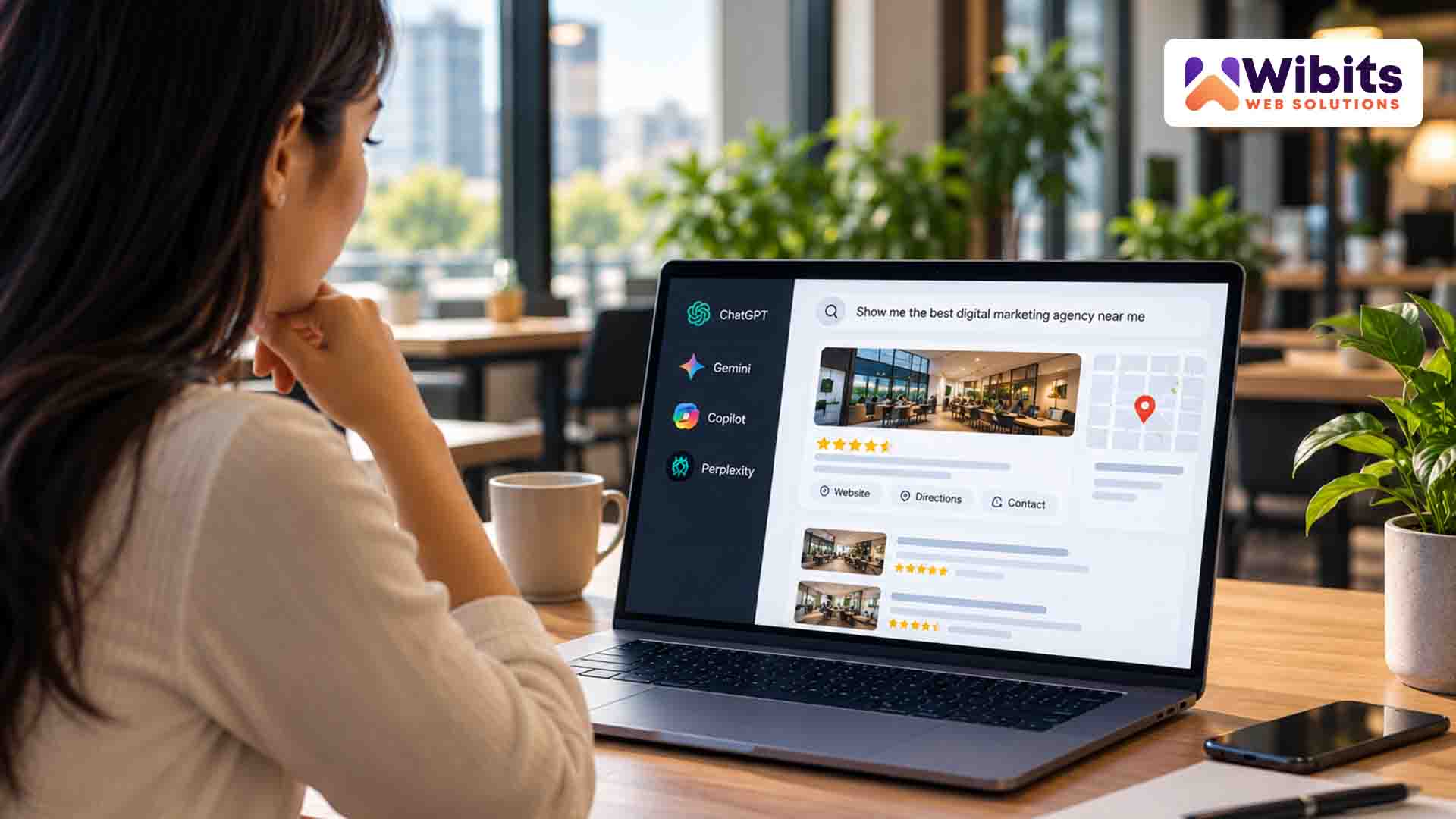
The internet search methods have changed. Now rather than accessing tens of sites one would inquire directly with the help of ChatGPT, Google Gemini, or Microsoft Copilot and receive answers in seconds.
For a digital marketing agency in India, this poses another question: What information will AI tools show about your business?
Does it give correct descriptions of the services provided? Does it tell about outdated information? Does it skip essential information? Does it even include your company in the search results for the inquiries made by the users?
With the advent of AI search, businesses have to innovate their approaches to online presence management. While classical SEO is still relevant, companies experience further challenges which imply that the information provided is clear, accurate, and available to the AI-based search systems.
AI Search Is Not the Same as Traditional Search
Regular search typically provides a list of links to those searching. This allows them to pick the website they wish to view and investigate.
AI search operates in another way by processing a question posed by the user and generating an answer by utilizing information from numerous sources. There are even times when it may not be necessary for the user to open any website.
For example, individuals may ask the following:
If the AI tool fails to detect information about a particular company, it will not mention it at all; if it gives the data which is no longer up-to-date or inaccurate, the searched answer may turn out to be wrong.
Thus, companies must think about more than just getting better rank for some keywords.
Many businesses update their websites only when they launch a new service or redesign the site. After that, the content may remain unchanged for years.
During that time, a lot can change.
Services may be added or removed. Team members may leave. Contact details may change. Business locations may move. Pricing, policies, and working methods may also be updated.
But the website may still contain the old information.
This can become a bigger problem when AI tools use public website content to answer questions about the business. An old service page may be treated as current. An outdated team profile may still appear in an answer. A previous address or phone number may be repeated.
The issue is not only whether AI can find your website. The bigger concern is whether it finds the right information.
Take a website that says a company provides five services, even though the company stopped offering two of them last year. A person asking an AI tool about that company may receive an answer based on those old services.
The business may not have intended to mislead anyone. The website simply was not updated.
AI tools need clear information. So do people.
A website filled with vague statements can make it difficult for both to understand what a business actually does.
Phrases such as “complete business solutions” or “next-generation services” do not explain much on their own. A visitor needs to know what is included, who the service is for, and what kind of problem the business can help solve.
Each main service should have its own useful explanation.
For example, a digital marketing company could explain its SEO, paid advertising, content marketing, social media, and website development services separately. It could also mention the types of businesses it works with and the areas it serves.
A local business should make its location clear. A web design company in Nagercoil, for example, should not expect every visitor to work out where it operates from a general statement on the homepage.
Clear service pages also make it easier for AI systems to connect a business with relevant questions.
If someone asks for SEO services in a particular location, a page that clearly explains the service, location, and type of customer served gives the system more useful information than a page filled with broad marketing claims.
Some information is too important to leave scattered across the website.
Businesses should regularly check details such as:
It is not necessary for every business to utilize all the elements on the list. What matters is ensuring that customers can access relevant service information easily.
Moreover, all contact details on the website, Google Business Profile, social media, and directories must be the same. Whenever customers see conflicting information about the same business, it can cause confusion about what information is accurate.
The same confusion can arise when a single website contains several pages that differentiate their services in small ways. One page may mention an old process while another explains the current one.
A regular content review can help find these differences before they cause problems.
Website content is often regarded as a marketing resource. Once a page is created, developers upload it on the site and companies start working on their next action plan.
This strategy may backfire in situations when the content has information that may influence the clients’ decisions.
For instance, a financial services company may have pages describing licenses, brokers, complaints, privacy policies, or obligations. If the content is either obsolete or confusing, it becomes a problem bigger than a low search visibility.
The same idea can be applied to other industries as well. Companies boasting about their qualifications, guarantees, prices, delivery time, safety of the service or professional services, should constantly check their claims for accuracy.
AI tools may lack the necessary context required to interpret the statement. A qualification, a condition, a disclaimer, or an exception may be lost on the original web page and not included in the answer.
Hence, companies should review important web pages using the same meticulous approach as in reviewing all other information put in public access.
Good content cannot do much if the website itself is difficult to use.
Broken links, missing pages, slow loading times, confusing menus, and mobile display problems can affect how people experience a business online. They can also make it harder for search systems to access important information.
Website design & development is crucial here. A basic website check should include:
Businesses should also avoid putting every useful detail inside images, videos, or downloadable files. Content that conveys the message well is easier to access for both audiences and understanding systems.
Having systematic information about a business is useful for search engines. They will be able to get information regarding details such as the business’s name, location, and services the local business is offering. It is not a magic method to get top-ranked in AI-generated answers but of great help in establishing communication between the website and the search system.
AI tools do not rely only on a company’s homepage.
They may also find information through business listings, reviews, news articles, social media pages, industry websites, and other public sources.
This makes it useful for businesses to keep their wider online presence accurate as well.
If you are a SEO company in India, you can describe yourself as an experienced provider on your own website, but potential customers may also look for reviews or examples of previous work. If your business has no visible activity outside its website, people may have less information to consider.
This does not mean a business needs to be active on every social media platform. It is more important to keep the platforms and listings that matter to the business updated.
Reviews should also be genuine and relevant. A detailed customer comment about the service provided is more helpful than several short comments that say very little.
The information across different platforms should make sense together. The business name, location, services, and contact details should not contradict one another.
One useful test is to search for the service your business provides without using the company name.
For example, instead of searching for your brand, try questions such as:
You can also ask AI tools similar questions and see what information appears.
This is not a perfect test. AI-generated responses can vary, and they might fail to include all the relevant companies. Nevertheless, the activity gives you the opportunity to see whether your website communicates exactly what services you provide and whether your business details are consistently presented on the Internet.
If the result is incorrect, outdated, or incomplete, you know that there is something specific to work on.
Preparing for AI-powered search does not always require a complete website rebuild.
Start by checking the information you already have.
Update old service pages. Remove services you no longer provide. Correct contact details. Add clear explanations where the website is vague. Check important links and forms. Review business listings and customer-facing profiles.
Then look at the website from a new visitor’s point of view.
Could someone understand what your business does in less than a minute? Could they find the right service? Could they confirm where you operate? Could they contact you without difficulty?
If the answer is no, those are the areas to fix first.
AI-powered search is still developing, but the basic requirement is fairly simple: your business information needs to be accurate, useful, and consistent wherever people may find it.
A website that is kept up to date gives both customers and search systems a better chance of understanding the business correctly.
The internet search methods have changed. Now rather than accessing tens of sites one would…

A small business already has plenty on its plate. Then it has to compete online…
A potential customer opens ChatGPT and asks, “Who are the best companies for SEO in…

For years, website owners have focused on one big question: Can Google find my website?…

Think about the websites you visit without even thinking twice. Maybe there's a technology site…
For years, the goal was pretty simple. Get your website onto Google. Get it near…

You wake up to an urgent notification, a harsh review, an old legal scrape, or…

Remember when building a decent website and tossing in a few keywords was enough to…

"I think we're done with Google Ads." A business owner said that recently. I didn't…