

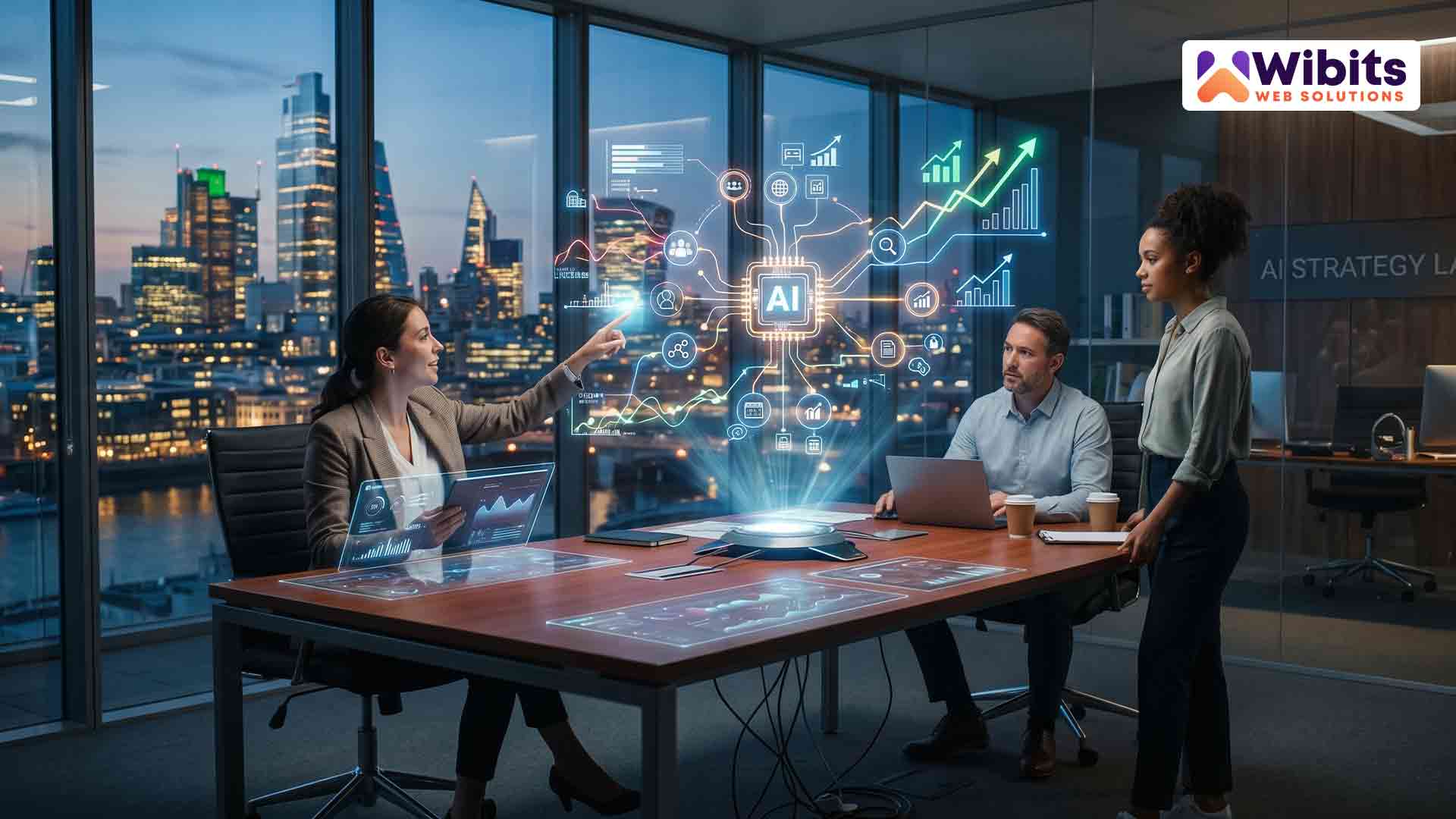
A few years ago, artificial intelligence felt like a futuristic concept reserved for tech giants. Today, it’s helping businesses write content, automate campaigns, understand customer behavior, and generate better marketing results faster than ever before.
But here’s the reality, simply using AI tools doesn’t guarantee success.
Many businesses are experimenting with AI without a clear direction. They use ChatGPT for content, automate a few emails, or run AI-powered ads, yet still struggle to improve conversions or engagement. The difference between businesses that win with AI and those that waste time often comes down to one thing: strategy.
An effective AI digital marketing strategy helps businesses use automation and data intelligently while keeping the human touch customers still value. Whether you’re a startup, an eCommerce brand, or a local business looking to scale, AI can become a powerful growth engine when implemented correctly.
In this guide, we’ll break down how to build an AI-driven marketing strategy step-by-step in a simple, practical, and conversational way.
AI is transforming the way businesses approach online marketing because it helps teams:
Instead of replacing marketers, AI enhances productivity and allows teams to focus on creativity, strategy, and customer relationships.
Businesses that adapt early are already seeing better performance in SEO, paid advertising, email campaigns, and customer engagement.
| Marketing Area | How AI Helps |
| Content Creation | Generates blogs, captions, ad copy, and ideas |
| SEO Optimization | Identifies keywords, content gaps, and ranking opportunities |
| Customer Support | Uses chatbots for instant responses |
| Email Marketing | Automates personalization and segmentation |
| Social Media | Schedules posts and predicts engagement |
| Advertising | Optimizes targeting and bidding |
| Analytics | Provides real-time insights and forecasting |
| Lead Generation | Scores and nurtures leads automatically |
Before introducing AI, evaluate your current marketing efforts.
Ask questions like:
AI works best when it improves an already structured process.
For example, if your business already creates blog content regularly, AI can help speed up keyword research, content planning, and optimization.
If your ads are underperforming, AI-powered analytics tools can identify weak points and audience behavior patterns.
One of the biggest mistakes businesses make is using AI without a clear purpose.
Your goals should be measurable and connected to business outcomes.
Examples include:
Once your goals are defined, choosing the right AI tools becomes much easier.
AI thrives on data.
The more accurate and organized your data is, the better insights AI tools can generate.
Analyze information such as:
Modern AI tools can identify hidden patterns in user behavior that humans may overlook.
For example, AI can reveal:
This allows businesses to make smarter marketing decisions backed by real insights instead of assumptions.
There are thousands of AI tools available today, but using too many can create confusion.
Focus on tools that align with your goals.
| Purpose | AI Tools |
| Content Writing | ChatGPT, Jasper, Claude |
| SEO Optimization | Surfer SEO, Semrush, Clearscope |
| Graphic Design | Canva AI, Adobe Firefly |
| Email Marketing | Mailchimp, HubSpot |
| Automation | Zapier |
| Analytics | Google Analytics 4 |
| Customer Support | Drift, Zendesk |
| CRM & Lead Management | Salesforce, HubSpot |
The goal isn’t to replace your marketing team, it’s to help them work smarter and faster.
Customers now expect personalized experiences.
AI helps businesses deliver tailored messaging based on:
For example:
This improves customer satisfaction and increases conversions significantly.
One of AI’s biggest advantages is automation.
Tasks that once took hours can now happen automatically, including:
This saves time and allows marketers to focus on creative and strategic work instead of routine manual processes.
Businesses that automate effectively often improve efficiency while reducing operational costs.
SEO has become more competitive than ever, and AI is now playing a huge role in search optimization.
AI-powered SEO tools help marketers:
Google is increasingly prioritizing high-quality, user-focused content. That means businesses need content that is both optimized for search engines and valuable for real readers.
A professional digital marketing company in Nagercoil like Wibits Web Solutions can combine AI insights with human expertise to create SEO strategies that actually drive traffic and conversions.
Also read: The Future Of Search: From Keywords To Intent-Based Discovery
Digital marketing is never “set and forget.”
AI helps businesses test campaigns faster through:
For example:
This constant optimization leads to stronger long-term results.
Tracking performance is essential for understanding what’s working.
Important KPIs include:
AI dashboards and analytics tools simplify reporting and provide actionable insights in real time.
This allows businesses to make faster decisions and adapt quickly to changing market conditions.
While AI offers incredible opportunities, businesses should also use it responsibly.
Potential concerns include:
The best approach is balancing AI efficiency with human creativity and oversight.
Customers still value authentic communication, emotional storytelling, and genuine brand personality.
AI should support your marketing, not completely replace the human element.
AI will continue evolving rapidly over the next few years.
Businesses that embrace AI strategically will likely gain advantages in:
However, success won’t come from blindly following trends. It will come from combining smart technology with clear business strategy and meaningful customer experiences.
That’s why working with the best SEO company in Nagercoil or an experienced digital marketing agency in India can help businesses implement AI tools effectively while avoiding costly mistakes.
AI is no longer just an optional marketing tool, it’s becoming a core part of modern business growth.
From automation and personalization to SEO and predictive analytics, AI gives businesses the ability to market smarter, faster, and more effectively than ever before.
But technology alone isn’t enough. Businesses need the right strategy, the right tools, and the right execution.
That’s where Wibits Web Solutions can help.
At Wibits Web Solutions, we combine AI-powered marketing strategies with real human creativity to help businesses grow online. From SEO and content marketing to automation, lead generation, and performance-driven campaigns, our team helps brands stay ahead in an increasingly AI-driven digital world.
If you’re ready to future-proof your marketing strategy, now is the perfect time to start.
1. What is an AI digital marketing strategy?
An AI digital marketing strategy uses artificial intelligence tools and technologies to improve marketing activities such as SEO, automation, personalization, analytics, and customer engagement.
2. Can AI replace digital marketers?
No. AI supports marketers by automating repetitive tasks and providing insights, but human creativity, strategy, and emotional understanding are still essential.
3. Which AI tools are best for digital marketing?
Popular tools include ChatGPT, Jasper, HubSpot, Canva AI, Google Analytics 4, Mailchimp, and Semrush depending on your marketing goals.
4. Is AI useful for SEO?
Yes. AI helps with keyword research, competitor analysis, content optimization, technical SEO insights, and improving search rankings more efficiently.

For years, website owners have focused on one big question: Can Google find my website?…

Think about the websites you visit without even thinking twice. Maybe there's a technology site…
For years, the goal was pretty simple. Get your website onto Google. Get it near…

You wake up to an urgent notification, a harsh review, an old legal scrape, or…
Remember when building a decent website and tossing in a few keywords was enough to…

"I think we're done with Google Ads." A business owner said that recently. I didn't…
You may have spent months working in SEO or working with a best SEO company…
Imagine walking into a hardware store looking for a certain type of strong garden hose.…
You open Google Analytics. The numbers don't look bad. People are visiting the website. Some…