

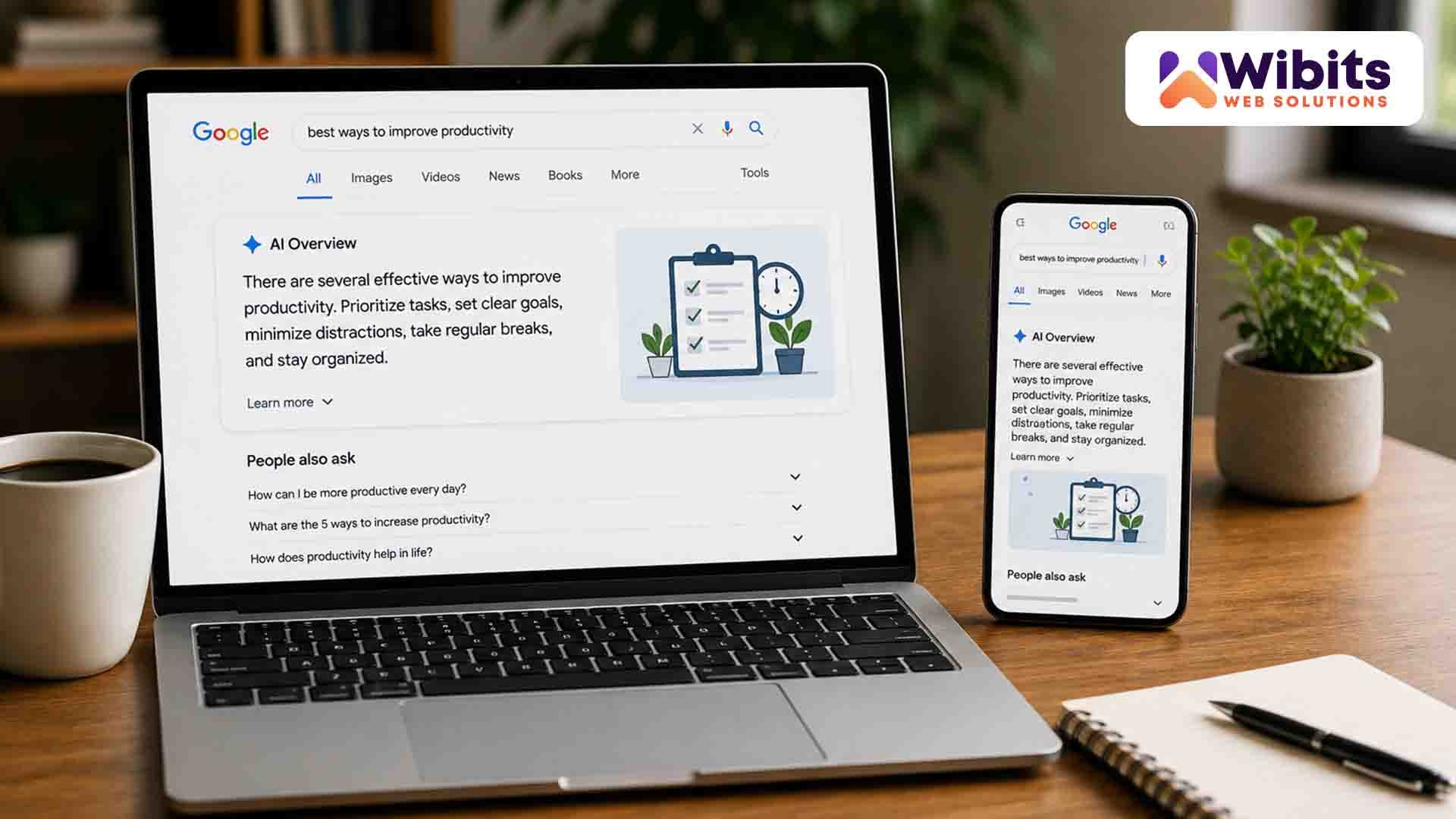
For years, the goal was pretty simple. Get your website onto Google. Get it near the top. Get the click.
That whole process is changing.
Search Google for a question today and you might get the answer before you’ve even looked at a website. AI Overviews and AI Mode can pull information together, explain it and point people towards sources without making the old ten-blue-links experience the centre of the page.
For a business that spent years building its SEO traffic, that’s a pretty big shift. The strange part is that people are still searching. They just aren’t always searching in the same way.
Think about how SEO worked for a local business. A person searches for something. Your page appears. They click. They read about the service. They look around the site. Then they call, enquire or buy. That click gave you a chance. You controlled what happened next.
Now a search can look very different.
A person can search for something quite specific and find the answer before they ever reach a website. That changes the game for businesses that have spent years treating the website visit as the main prize.
No chance to show them your carefully designed homepage. That doesn’t mean SEO has stopped working. It means the old idea of SEO rank, get clicked, convert isn’t the whole story anymore.
This is probably the hardest part for marketers to accept. Not every search needs a website visit.
If somebody searches for the weather, a conversion isn’t waiting at the end of a blog post.
If they’re checking how many ounces are in a pound, the number itself is probably all they came for.
Search engines have been answering simple questions for years.
AI has simply pushed that idea much further.
People can now ask longer, messier questions and get a response that pulls several pieces of information together.
Google says AI Overviews are leading people to search more and ask longer, more complex questions. People can still click through to websites when they want more detail. They just don’t have to start there anymore.
Both things can be true.
People can search more. And click less on some searches.
Imagine a person searching: “What’s the best way for a small business to reduce its Google Ads costs?”
They get an AI-generated answer.
Your company isn’t linked prominently. But your article is one of the sources used to build the response. The searcher may not click. They still saw your brand. That’s not the same as getting website traffic.
It isn’t worthless either. It’s a different kind of visibility.
Google is actively adding more ways for people to discover and revisit original websites within AI Search, including inline links, website previews and preferred-source features.
The important point for marketers is that visibility is getting bigger than the blue link.
A page written only to rank for one keyword starts looking pretty weak in this environment.
It might have the keyword in the title. The keyword appears in every other heading. You can spot these articles pretty quickly.
The same points are repeated, the paragraphs keep getting longer, and the answer could have been given in half the space. By the end, you’ve learned very little that you couldn’t have found somewhere else.
Also read: What is the right blog post length?
That approach was never particularly good writing. Now it’s an even shakier strategy.
Useful content has to give people something worth remembering.
A clear explanation.
Firsthand experience.
A useful example.
An opinion based on actual work.
Original information.
A detail that isn’t repeated on fifty other websites.
Those are the things that give a page a reason to exist.
Look at how people talk to AI tools.
They ask:
“Why am I getting loads of Google Ads clicks but hardly any enquiries?”
That’s a completely different search.
It contains a problem.
A situation.
A little frustration.
And a much clearer idea of what the person actually wants.
Google’s AI Search is built around this kind of longer, more complex questioning. AI Mode makes search feel more like a conversation. You ask something, add another question, change the details and keep going from there.
Businesses need to pay attention to that shift. Not because every keyword has suddenly become useless. Because the person behind the keyword is becoming easier to understand.
Google can handle the basic answer now. So when people reach your website, repeating that answer isn’t going to do much.
Give them something extra to work with a real example, useful experience, a different point of view or information they won’t find on every other site.
Say a person searches for a SEO company India.
Google can explain what SEO is.
It can explain how that company works.
It can even give a rough idea of what businesses should expect to pay.
None of that tells the person whether your agency is good at handling their particular account.
That’s where your website still matters. Show the work. Explain how you approach campaigns. Talk about mistakes you’ve seen. Give examples. Make it easy for a potential customer to work out whether you’re the right fit.
The information that gets someone interested isn’t always the information that gets them to contact you.
This is going to be uncomfortable for a lot of content marketers.
There are thousands of articles explaining the same basic topics.
“What is SEO?”
“What is PPC?”
“How does content marketing work?”
“Why is digital marketing important?”
Search for any of them and you’ll find more explanations than anyone could possibly read. AI can summarise most of them in seconds. That doesn’t mean businesses should stop writing.
It means the lazy version of content has a much harder job ahead. If your article says exactly what every competitor says, there isn’t much reason for Google or a reader to remember it.
The stronger article usually comes from somewhere else.
A real campaign.
A failed experiment.
A client problem.
A result that didn’t go according to plan.
A lesson learned after doing the work.
That’s information people can’t get simply by asking an AI to write a generic introduction to the subject.
Every time search changes, somebody announces that SEO is dead. We’ve heard this before.
Social media was going to kill search.
Voice search was going to kill websites.
Featured snippets were going to kill clicks.
Now AI is supposedly going to kill SEO.
The reality is less dramatic.
People still need information.
Businesses still need to be discovered.
Google still has to find useful pages to reference.
The format is changing.
The job is changing with it.
SEO is moving further away from simply trying to push a page into position and closer to making a business genuinely visible across the places people research.
That’s a much bigger job than adding keywords to a page.
This is where marketers need to be careful. Suppose organic traffic drops. The immediate reaction is obvious. Something went wrong.
But what if fewer people are clicking because they got part of the answer directly from the search page? Traffic would fall. That doesn’t automatically mean your visibility disappeared.
You need to look further.
Are branded searches increasing?
Are enquiries still coming in?
Are people spending more time on important pages?
Are your products or services appearing in AI-generated answers?
Are people finding you through other channels before visiting later?
A traffic report can tell you what happened.
It can’t always tell you why.
Paid search isn’t suddenly irrelevant either.
Paid search still has one big advantage: you’re reaching people who are already looking for something.
But getting the click isn’t enough.
If your ad says one thing and the landing page says another, the visitor isn’t going to stick around and figure it out for you.
The ad gets them there.
What happens after the click is up to the page.
Yet plenty of businesses still send expensive paid traffic to pages that weren’t built to turn that traffic into anything useful.
AI can summarise your business. Google can describe your services. Search results can introduce your brand. But a website gives people somewhere to go deeper. That’s still valuable.
A potential customer can read about your approach. See your work. Look at your services. Check your credentials. Read a case study. Find your contact details.
The website doesn’t have to win the entire argument in one visit. It just needs to make the next step easy.
For a long time, digital marketing revolved around one simple idea:
Get the click.
That still matters.
It just isn’t the whole game anymore. A person can discover your brand without clicking. They can read an AI-generated answer that includes information from your site.
They can see your name, forget it, come across it again a week later and finally search for you directly.
None of that fits neatly into the old traffic report.
Search is becoming less like a list of websites and more like a conversation between the person, the search engine and the wider web.
Businesses don’t need to panic about that.
They need to make sure there’s something worth finding when their name enters that conversation.
That’s where good content, useful websites, strong SEO and sensible paid campaigns still have a place.
The click isn’t disappearing.
It’s just no longer the only thing that matters.
Google has a new system called SAFE, and it has caught the attention of people…
Think about the last time you searched for something online. Most of the time, you…
The internet search methods have changed. Now rather than accessing tens of sites one would…
A small business already has plenty on its plate. Then it has to compete online…
A potential customer opens ChatGPT and asks, “Who are the best companies for SEO in…

For years, website owners have focused on one big question: Can Google find my website?…

Think about the websites you visit without even thinking twice. Maybe there's a technology site…
For years, the goal was pretty simple. Get your website onto Google. Get it near…
You wake up to an urgent notification, a harsh review, an old legal scrape, or…
Remember when building a decent website and tossing in a few keywords was enough to…